
 Annual vaccinations are one of the most important preventative measures you can take for the health of your pet. Click here to see a list of recommended veterinarians in our area. At PAWS Shelter of Central Texas, we ensure that every cat is provided the following vaccinations:
FVRCP
- Feline Panleukopenia – Also known as Feline Distemper. This virus is transmitted through blood, urine, feces, nasal secretions and even fleas from affected cats. The virus attacks the cat's white blood cells. Symptoms include vomiting, diarrhea, and fever. The disease is fatal in over 50% of cases. Prevention is critical.
- Recommendation: Initially, kittens need a series of three to four vaccinations, administered one month apart, followed by yearly booster vaccination.
- Feline Viral Rhinotracheitis, Calicivirus, and Pneumonia – These are diseases that cause respiratory symptoms. They are all highly contagious and widespread. High death rates occur in very young and older cats. Signs of these diseases include sneezing, fever, nasal discharges, coughing, conjunctivitis (eyelid inflammation/infection), mouth ulcers, lack of appetite, and general depression.
- Recommendation: Kitten series followed by yearly booster vaccination.
RABIES
- Rabies Virus – This virus attacks the nervous system of animals and humans. It is categorized as a zoonotic illness, meaning it is transmissible to all mammals. The virus is typically spread via saliva through bite or scratch wounds. Texas State law requires that all cats be vaccinated annually against Rabies beginning at four months of age.
- Recommendation: Kittens should be vaccinated between 12-16 weeks old followed by an annual booster. If the cat is boostered within the correct timeframe, they can be eligible for three year booster vaccinations from that point on.
OTHER VACCINE CONSIDERATIONS
FELINE LEUKEMIA VACCINE
- Feline Leukemia – Sadly, feline leukemia virus is still a leading cause of death in infected cats. The virus causes a suppression of the cat's immune system. Transmission occurs through cat bites, casual contact with an infected cat and from an infected mother cat to her kittens. There is no successful treatment once signs develop. This vaccine is not given at PAWS due to the propensity for negative reactions, but you should discuss with your veterinarian whether or not this vaccines is right for your cat.
- Recommendation: Two-step series of kitten vaccines followed by annual boosters. For all cats exposed to the outdoors.

Most owners are not aware what the procedure of declawing a cat actually entails. Cat claws actually grow from the bone at the end of the toe. In order to remove the claw, the bone must also be removed. This is the equivalent to cutting off a human’s finger at the last joint of each digit. As cats walk on these digits after the bone has been removed, you can imagine it leads to a painful recovery process and, if not done properly, can lead to severe arthritis at an older age.
“There's a long-running debate as to whether a piece of bone should be left or removed [during surgery]. Left in, it can feel like a permanent pebble in a shoe, which is darned uncomfortable. But if the piece of bone is removed, the tendons will contract even further and can cause ever malpositioning of the toes, which changes how the paws bear weight.”
DECLAWING = SURGICAL AMPUTATION OF TOE BONES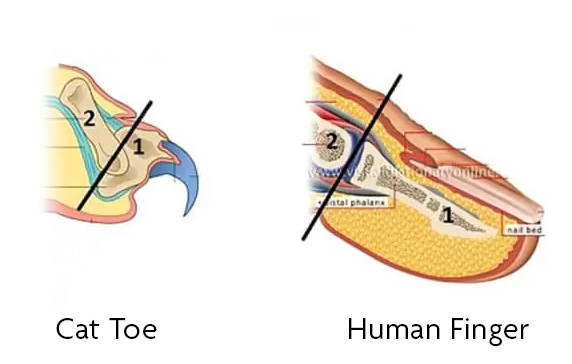
Declawing a cat involves cutting the bones and soft tissue (including their paw pads) attached to their claws. This is comparable to cutting the finger tips from a human hand. This procedure commonly leads to a host of issues including:
COMMON ISSUES ASSOCIATED WITH DECLAWING:
- Balance Issues
- Muscle Problems
- Infection & Stress Related Illnesses
- Biting
- Litterbox Issues
- Phantom Pain and/or Chronic Pain
- Inability to Groom
- Deformity
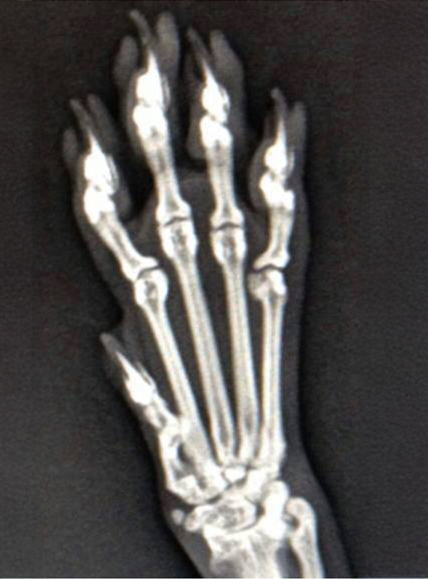
A non-declawed, natural cat paw.
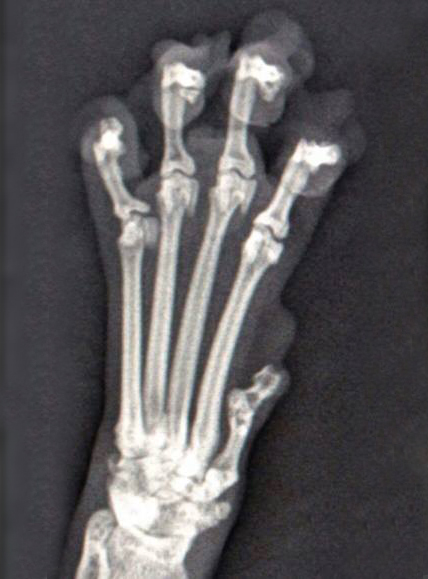
A declawed cat paw showing obvious deformity.
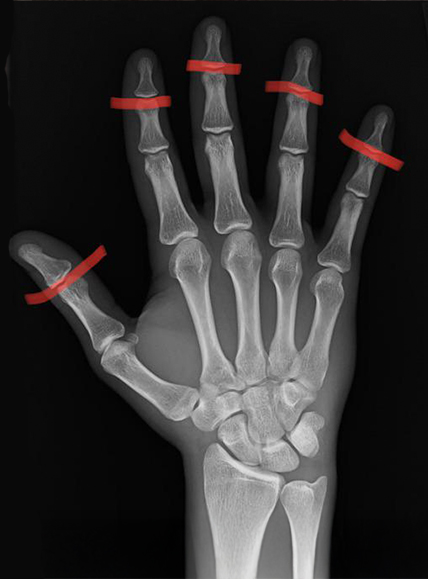
A comparison of the bones amputated on a human hand.
How Do You Treat Heartworms?
All dogs can be infected with heartworms regardless of age, location, or the time of year. It is critical that you protect your dog with a veterinarian approved heartworm prevention. At your annual veterinary exam, your veterinarian will recommend heartworm testing.
If your dog tests positive for heartworm infection, there is only one approved treatment option. This treatment is lengthy, extremely painful, and expensive. Unfortunately, without treatment, your dog will eventually succumb to the infection which will result in heart and lung failure. This is why we insist adopters keep their dogs on heartworm prevention year round.
MYTH: Indoor cats get bored and need to be outside for stimulation.
FACT: The truth is, indoor cats can and do get bored, but letting them outside is not a good solution. Instead, make your home more interesting for your cat! Set up perches where they can watch birds through a window, get a cat playhouse, hide their food or modify their feeder se they need to “hunt” for it, use a laser pointer or other various cat toys, train your cat (yes, they can learn tricks!), play “cat TV” videos. Finally, if your cat is amenable to it, you might consider adopting a second cat as a playmate!
MYTH: Indoor cats are overweight.
FACT: If your cat is overweight, the safest way to help them trim down is by combining portion control and a daily exercise and play routine. Stop free-feeding your cat, or at least be mindful to only feed a healthy amount per day.
(Yes, cats do and will overeat if you let them. Consult your veterinarian about how many calories your cat should be eating in a day.)
Have a cat who won't stand for an empty food dish? Keep them distracted with the activities mentioned above – the feeder toy would be a perfect solution! If you feed canned food, try stuffing a smaller dog toy (ex. Kong toys) with the food so your kitty will have to work for it. You can also choose to use an automatic feeder that works for both wet and dry food, so you have options. Cats LOVE a schedule. Try feeding them at the same time each day and you kitty will get used to the routine quickly.
Just remember to check with your veterinarian before starting any new feeding plans.
MYTH: Indoor cats are destructive.
FACT: Destructive behavior is often a sign that something else is going on. Is your cat sick? Bored? A talk with your vet or a behaviorist may be in order. However, solving the problem might be simpler than you think.
MYTH: My cat's always been allowed outside, so he can't be indoor-only.
FACT: Many cats have successfully gone from outdoor-only to indoor-only. The key, again, is making sure the indoor environment is just as interesting as outside – and being vigilant about preventing escape attempts. While there are many fun things outside, there are exponentially more dangerous things as well.
MYTH: My cat is safe when he goes outside because he stays close to my home.
FACT: A study of 10 house cats and seven farm cats published in the European ecology journal found that on average, house cats covered more ground than farm cats – at night, the house cats moved within an average area of nearly 20 acres, compared to just over 6 acres for the farm cats. A lot can happen even within a small radius of your home, so if you really want to let your cat outside, consider harness training or creating a screened-in enclosure for them.
MYTH: I need to let my cat out of the house because I'm allergic to them.
FACT: You may well be allergic to your cat, but it's possible you're actually allergic to something they are bringing in from outside. Indoor/outdoor cats pick up fleas, ticks, pollen, and other allergens from the environment. If you really are allergic to your cat (an allergy test will tell you for sure), there are some easy ways you can reduce the allergens in your home – even when your cat is indoor-only.
- Litter box cleanliness. Some cats are extremely particular about litter hygiene. Some will not use a litter box that contains any urine or feces. Others won’t share. If the box is not clean enough, or if you don’t have enough boxes for the cats to share, they will seek out other areas (clothing, soft surfaces, etc.) to relieve themselves.
- Litter box location. Avoid placing the box near the cat’s food and water. Also avoid placing it either in an area that’s too busy (not allowing them privacy) or so isolated that family members may forget to clean it. Avoid placing it in corners or closets where the cat may be ambushed by another cat (if in a multi-cat household). We recommend one litter box per cat, plus one extra. If you have more than one floor on your house, you’ll need a litter box on each floor.
- Litter preference. Most cats prefer a litter with the following three qualities: it should be a base material the cat doesn’t mind standing on, loose enough for the cat to dig and cover feces/urine, and it should be unscented. Avoid changing the brand of litter suddenly, as this may cause the cat to avoid the box.
- Stress. Many people are unaware of how stressful the smallest changes can be to a cat. While moving, new pets, grief, changes in routine, and changes in family dynamics are common causes, cats can also be upset by rearranged or new furniture, changes to litter box locations (even a few feet away), and different brands of litter, among other causes. Give your cat plenty of attention, play time, care, and reassurance in times of stress to help them adjust.
- Medical conditions. Medical problems can cause pain to the cat and lead him to avoid his box. Have your cat thoroughly checked by a veterinarian to determine I a physical malady is causing the problem.
- Provide the right scratching post. The post must be sturdy enough that the cat cannot tip it and tall enough for the cat to fully stretch. This allows the cat to adequately stretch its back muscles. The post should be covered with sisal, rope, or any rough material.
- Location, location. Keep the post plainly visible; do not hide it in the spare bedroom! You want the post to be accessible to the cat when you come home, after they wake up, and after eating. This won’t happen if he can’t find it!
- Introducing your cat to the post. Encourage your cat to use the scratching post by using treats, toys, catnip to lure them into a sctretching position. Praise them for using their post instead of the couch.
- No punishment. Scratching is a normal behavior so it cannot be reprimanded. Focus on redirecting the cat back to his post with the game described above.
- Make your furniture unappealing to the cat. To deter your cat from scratching your furniture, use tin-foil or a product called “Sticky Paws”. Apply this to areas the cat has already been scratching. Place the post right next to the furniture. When the cat has been routinely using the spot instead of the furniture, gradually move it (an inch or so each day) to where you want it permanently located, remembering that it should still be highly visible.
- Soft Paws. You might also consider Soft Paws, little plastic caps that can be applied to your cat’s nails. The cat will still attempt to scratch, but the caps will prevent damage to your furniture.
- Start by giving your kitty its cat condo or high-up place to hang out. More interactive playtime with toys will provide more mental stimulation.
- Make counters and other surfaces unappealing. You can use cookie sheets or cheap placemats with tin-foil or “Sticky Paws” attached to them.
- Praise your kitty for using his cat tree and make it a fun place to be.
- Give the cat appropriate outlets for playful behavior. Plenty of interactive playtime and solo play toys. Never encourage your cat to play with human body parts. This will only teach them that biting hands, feet, etc. is acceptable.
- This is one case where correction is appropriate. Use only humane correction: saying “NO” or “OUCH” (loudly if necessary), clapping your hands, or blowing air on the cat’s face as it bites. Back away from them slowly and quietly. Then withdraw attention, giving the kitty a “time-out” for 30 seconds or so.
- Encourage good playful behaviors by rotating toys and making playtime a routine event. Utilize feathered wands or similar products to distance your hands from the cat.
Let's start with what not to do: tossing two strange cats together and hoping they will “work it out” is not the vibe. It's important to remember that cats are, by nature, solitary and highly territorial creatures who often require weeks, or months, to adjust to changes in their environment and lifestyle. For that reason, first impressions are extremely important when meeting other household pets. Cats who are introduced too quickly and fight may never learn to co-exist peacefully, so a gradual introduction is essential for long-term success.
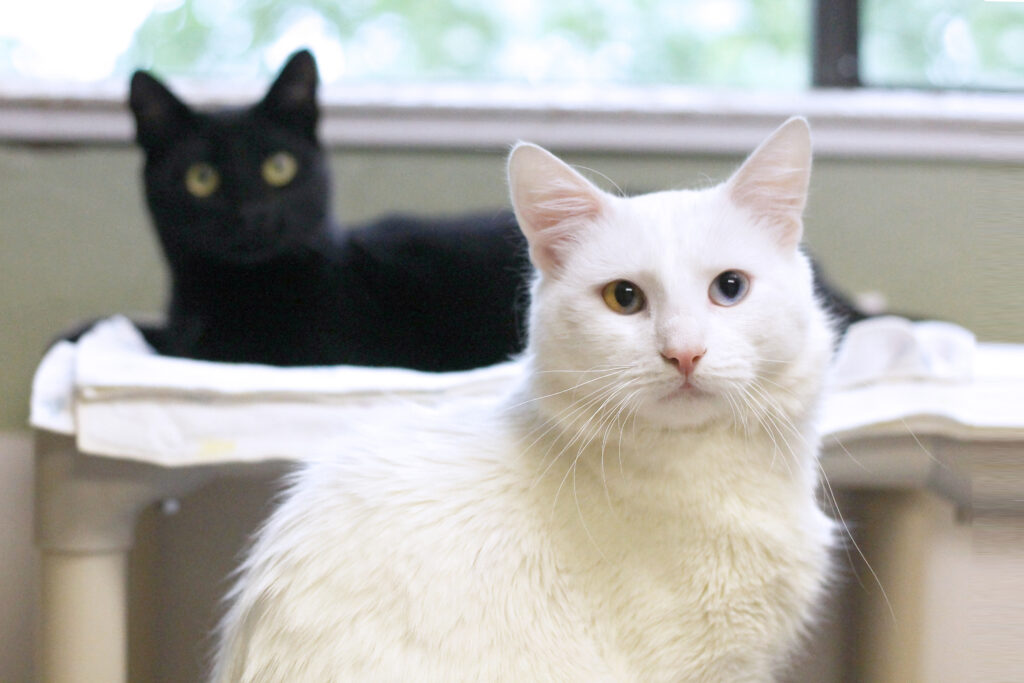
STEP 1:
When you bring your new cat home, confine him to one room with his own litter box, bed, food, and water for a week, or at the very least until he has been examined by your veterinarian. At the next meal, place the two cats' bowls on either side of the door to that room. The aim is for the cats to associate the pleasurable actively of eating with the presence of the other cat. Gradually move the bowls closer with each feeding. When they can eat calmly with bowls directly across from each other on each side of a door, open the door a crack – for just a few seconds – so they can see each other as they eat.
STEP 2:
Once the new cat seems comfortable in his new surroundings, is eating well, and using his litter box, confine your resident cat in another room and let the new cat explore the house. This allows the new cat to come in contact with the resident cat's scent without direct contact. An additional option is to exchange the cat's bedding for a night.
STEP 3:
Monitor the cat's first actual encounter closely and limit the time they spend together at first. Some display of fearful or aggressive behavior (crouching, hissing, ears back, growling) is to be expected, but you want to avoid letting them establish a pattern of aggressive or fearful behavior, which may be difficult to change. If these behaviors intensify, separate the cats again and go back to step one. If an actual fight breaks out, throw a towel over them (don't pick them up!) and give them a few days to calm down. Do not hold either cat in your arms during introductions. If either one reacts aggressively to the other cat, you could be scratched or bitten.
STEP 4:
Continue to provide supervised encounters with both cats, watching closely for signs of tension or aggression. If one cat appears to be freezing, staring, or fixating on the other cat, have some treats or fun toys nearby to redirect their attention away from each other. This will also continue to teach them that good things happen when the other cat is near.
Be sensitive to what a big change this is for your resident cat. Even if you think he's being obnoxious and unreasonable, give him the security of his usual routine and his own special time with you.
Keep in mind that “success” doesn't necessarily mean that your cats will be best buddies. Some cats become bonded to one another while others spend the rest of their lives avoiding and hissing at each other. Realize that either of these scenarios might happen. Your goal in facilitating introductions is to se the stage for the cats to peacefully share their living quarters, but understand you simply cannot “make” them like each other.

Despite the stereotype of “fighting like cats and dogs”, many dogs learn to live peacefully with cats, whether puppies or adults. The most important thing for adopter to know is that this adjustment is a process, not a one-time introduction. Care must be taken to introduce dogs and cats slowly, making the process an stress-free and pleasant as possible. Adopters must then be prepared to manage their pets' interactions for the next several weeks, if not longer.
- Keep the pets separate for at least the first 3-4 days. Some families confine their cat in a sanctuary room with the door closed and others confine each pet to a separate floor of their house. The goal is to allow the pets to get used to each other's presence without face-to-face contact. Even if they can't see each other, they can hear and smell each other.
- While the pets are still separate, begin to feed them on opposite sides of a closed door. The idea is to teach them to associate the presence of the other pet with pleasant things, such as food. With each feeding, move their food bowls a little closer to the closed door; continue the process until each pet can eat calmly right next to the door.
Despite the stereotype of “fighting like cats and dogs”, many dogs learn to live peacefully with cats – puppies and adults alike. The most important thing for adopters to know is that this adjustment is a process, not a one-time introduction. Care must be taken to introduce dogs and cats slowly, making the process as stress-free and pleasant as possible. Adopters must then be prepared to manage their pets' interactions for the next several weeks, if not longer, to ensure the safety of all involved.
While careful introductions are the best way to set your pets up for success, there is no guarantee that your cat and dog will become buddies. Some pets learn to tolerate each other, while others might attempt to cause each other harm. The outcome will depend on the manner of the pets' introduction and their individual personalities. The following steps can help to maximize your chances of long-term success.
- Keep the pets separate for the first 3-4 days. Some families confine their cat in a sanctuary room (i.e. bathroom, spare room, etc.) with the door closed and others confine each pet to a separate floor of their house. The goal is to allow the pets to get used to each other's presence and scent without face-to-face contact. Even if they can't see each other, they can hear and smell each other.
- While the pets are still separate, begin to feed them on opposite sides of a closed door. The idea is to teach them to associate the presence of the other pet with pleasant things, such as food. With each feeding, move their food bowls a little closer the closed door; continue the process until each pet can eat call right next door.
- When the pets can eat their food calmly right next to the door, begin face-to-face meetings. Keep the first few sessions short and calm. Keep the dog on a leash and let the cat come and go as they please. Do not restrain either pet in your arms as this could lead to injuries if either pet becomes scared or aggressive. Ask the dog to sit and reward them with small, tasty treats for calm behavior. You can offer treats to the cat as well. If either pet demonstrates aggression, calmly distract and redirect them using a toy or treat. If the situation escalates quickly, you can use a towel or blanket to safely corral the cat out of the room. Be sure to reward your dog whenever he responds by making eye contact with you when calling his name. Return the pets to their separate areas.
- If the pets did not react in a highly aggressive way, repeat these face-to-face sessions daily. If the cat attempts to leave the room, allow them to do so, and do not let the dog chase.Try to end each session on a high note, before either pet shows signs of stress or aggression. These meetings should take place in a “common area” of the house. It is not recommended to use either pets' sanctuary space.
- When both animals appear to be getting along well, allow them loose in the room together, keeping the dog's leash attached and dragging on the floor. This will allow you to step on it and prevent the dog from chasing the cat if they get excited. If tension erupts between them, go back to the earlier introduction steps and repeat the process. Make sure the cat has access to a dog-free area at all times, complete with a litter box. Continue to keep the pets separate when you are not home or sleeping at night until you are certain they will be safe alone together.